Animals That Live Underground — And Why Only the Mole Made It Into the Game
More animals dig and live in the ground than you'd think.
Each builds a burrow of a different shape, for a different reason.
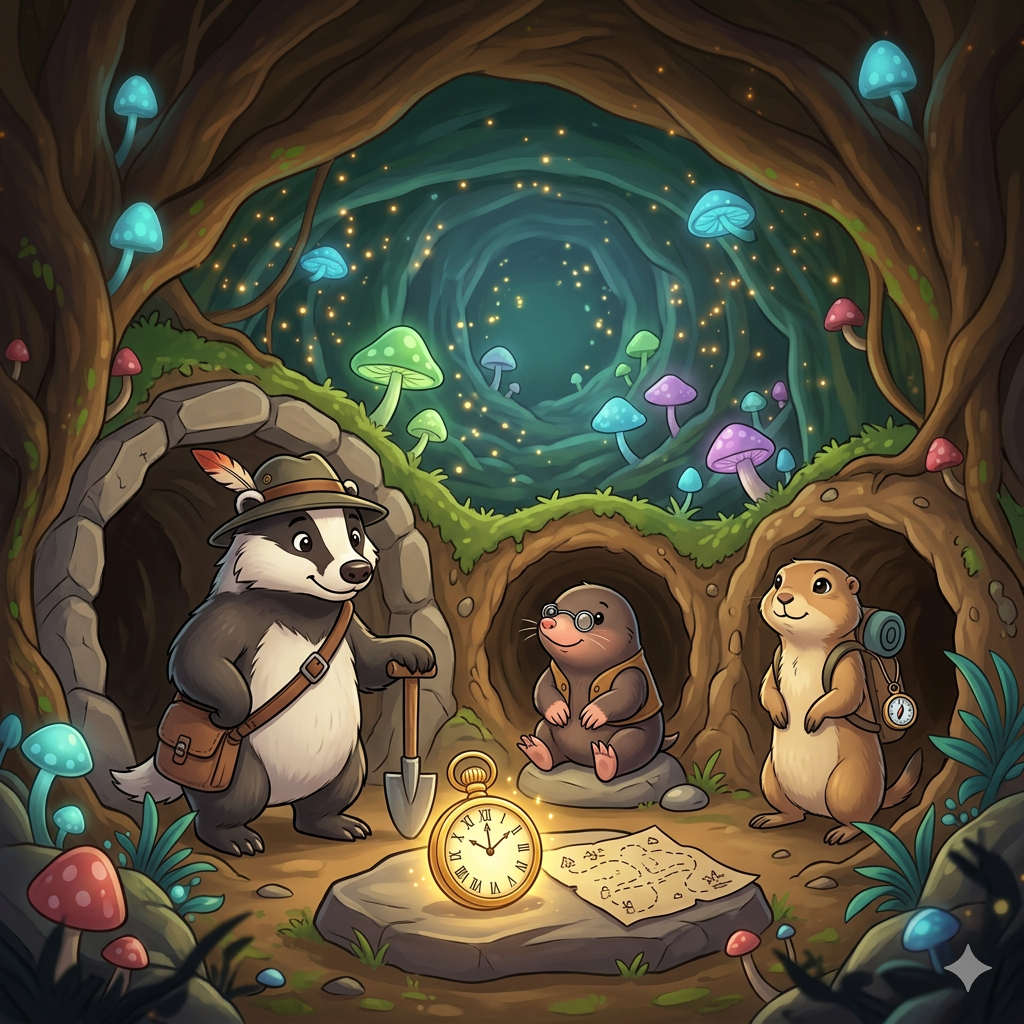
The mole is a master digger.
Pushing soil aside with broad, shovel-like forepaws, it carves tunnels through the earth.
For a mole, a burrow is both home and hunting ground — it eats the earthworms and bugs that fall through the dirt walls as it travels its tunnels.
Those little mounds that bulge up above the surface are the leftovers of that excavation.
The prairie dog is a squirrel-family animal that lives on the North American plains, where many of them gather to form a large underground town.
Burrows are divided by purpose, and when a predator appears they send the alarm to one another with their distinctive call.
A badger's burrow is called a "sett," and it gets used across generations, growing larger all the while.
Some setts have many entrances.
So underground turns out to be a busier neighborhood than you'd expect.
For some it's a hunting ground, for some a town, and for others a home handed down generation after generation.
Only the mole made it in
Somewhere along the burrow Mocha is digging, there is one neighbor who settled in first: a mole.
There's a reason it was the one I picked.
What defines a prairie dog town or a badger's sett is space — wide burrows, many rooms, many entrances.
But this game's burrow is a single unbranched tube, so there's nowhere to show that kind of structure.
The mole is different.
What defines a mole isn't space, it's movement — traveling through the wall and popping out unexpectedly.
That translates perfectly well into a single tube, and it happens to be exactly the kind of threat a runner needs.
Static obstacles and moving ones
Rocks and roots hold still.
What they demand is reaction: see it, dodge or jump, and you're fine; be late and you're hit.
The mole is different.
It drifts slowly back and forth along the wall while popping in and out of it.
Dodging based on where it is gets you hit; you have to read which way it's heading and go the other way.
It's an obstacle that asks for prediction rather than reaction.
Because of that, moles don't appear early.
They start showing up once you've descended a while.
Demanding prediction from someone who hasn't settled into the controls just produces deaths that feel unfair.
It keeps the difficulty curve in order: learn to react, then learn to predict.
Its movement speed is deliberately slow, too.
Something darting quickly back and forth turns prediction into luck.
Moving slowly is what gives the player time to read the direction and respond.
Different burrows, different neighbors
In the Moonlit Burrow, meteors cross the ring instead of moles.
The principle is the same moving obstacle, with one rule changed.
Where a mole goes back and forth, a meteor travels one direction only, and much faster.
So the counterplay inverts.
With a mole you can wait for it to turn and slip behind it; with a meteor waiting is fatal, and you have to commit to crossing well ahead or dropping clearly behind.
Changing a single rule on the same kind of threat turned out to change the whole character of the burrow.
A mole's body was redesigned for digging
Moles are master diggers because of how they're built, not because they work hard.
The forelimbs attach at the sides of the body facing outward, so instead of reaching forward they push soil sideways — closer to a swimmer's stroke than a shovel.
The wrist carries an extra bone beyond the five fingers.
Sitting beside the thumb, it widens the blade.
It isn't a real finger; a wrist bone enlarged until it works like a sixth one.
Life underground brings other problems.
Air moves poorly through a tight burrow and carbon dioxide accumulates.
A mole's hemoglobin binds oxygen more tightly than a surface animal's, which lets it keep working in air that would leave others struggling.
The eyes have nearly regressed, but the tip of the snout is packed with touch receptors.
Finding tunnels and prey in the dark is a job for the nose.
Digging is expensive, so moles eat almost continuously — which is where the claim that they eat close to their own body weight in a day comes from.
Burrows outlive the animals that dug them
The real influence of burrowing animals extends past their own housing.
A prairie dog town's tunnel system persists after the colony leaves, becoming shelter for animals that can't dig.
One species of owl nests in the abandoned burrows outright; snakes, lizards, and insects move in as well.
The soil effects are just as large.
Digging mixes deep soil with the surface layer, and rainwater soaks in along the tunnels.
Animals that reshape their own habitat this way are called ecosystem engineers.
A beaver's dam is the famous example — burrowers do the same work, just less visibly.
So calling the underground crowded isn't a figure of speech.
Diggers, borrowers, and inheritors are stacked on top of one another down there.
The numbers the mole was given
The values attached to the game's mole show the design intent directly.
Moles appear only below 160m.
Before that it's rocks and roots.
That number is the rule about teaching reaction before prediction.
Their side-to-side sweep runs at 1.0 radians per second.
Mocha rotates around the wall at up to 3.2 — the player is 3.2× faster than the mole. You can outrun one whenever you decide to.
What makes a mole dangerous isn't speed, it's that it changes direction.
The pop-up motion runs on its own clock: 2.2 radians per second, so roughly one bob every 2.9 seconds against a sweep cycle of about 6.3.
The two periods deliberately don't divide evenly, so the combined motion never repeats the same pattern.
That mismatch is why moles read as unpredictable.
Why meteors are so much worse
Meteors in the Moonlit Burrow travel one direction at 2.6 radians per second.
Against Mocha's 3.2, that's a margin of only 1.2×.
Against a mole, the 3.2× cushion means a late reaction is still recoverable.
Against a meteor you have to commit fully just to get across first — and since it never comes back, waiting isn't a strategy.
Practically the entire difficulty gap between the two obstacles comes from that one number.
Which is why meteors could afford to appear shallower, from 80m.
They're harder, but the rule is simple: it comes from one direction, so move now.
Moles invert that — a complicated rule with generous margins.
Two different ways of building difficulty.