Do Rabbits Really Love Carrots? — And What Carrots Actually Do in the Game
Rabbits make you think of carrots, and carrots make you think of rabbits.
In this game, too, Mocha scoops up carrots as she tumbles downward.
But the idea that carrots are a rabbit's main food is actually closer to a made-up image than the truth.
The cartoon character Bugs Bunny is often blamed for this impression.
That scene of Bugs crunching a carrot while wisecracking was a parody of an actor biting into a carrot in a famous 1930s film.
As the cartoon became a worldwide hit, the equation "rabbit = carrot" got cemented in everyone's heads.
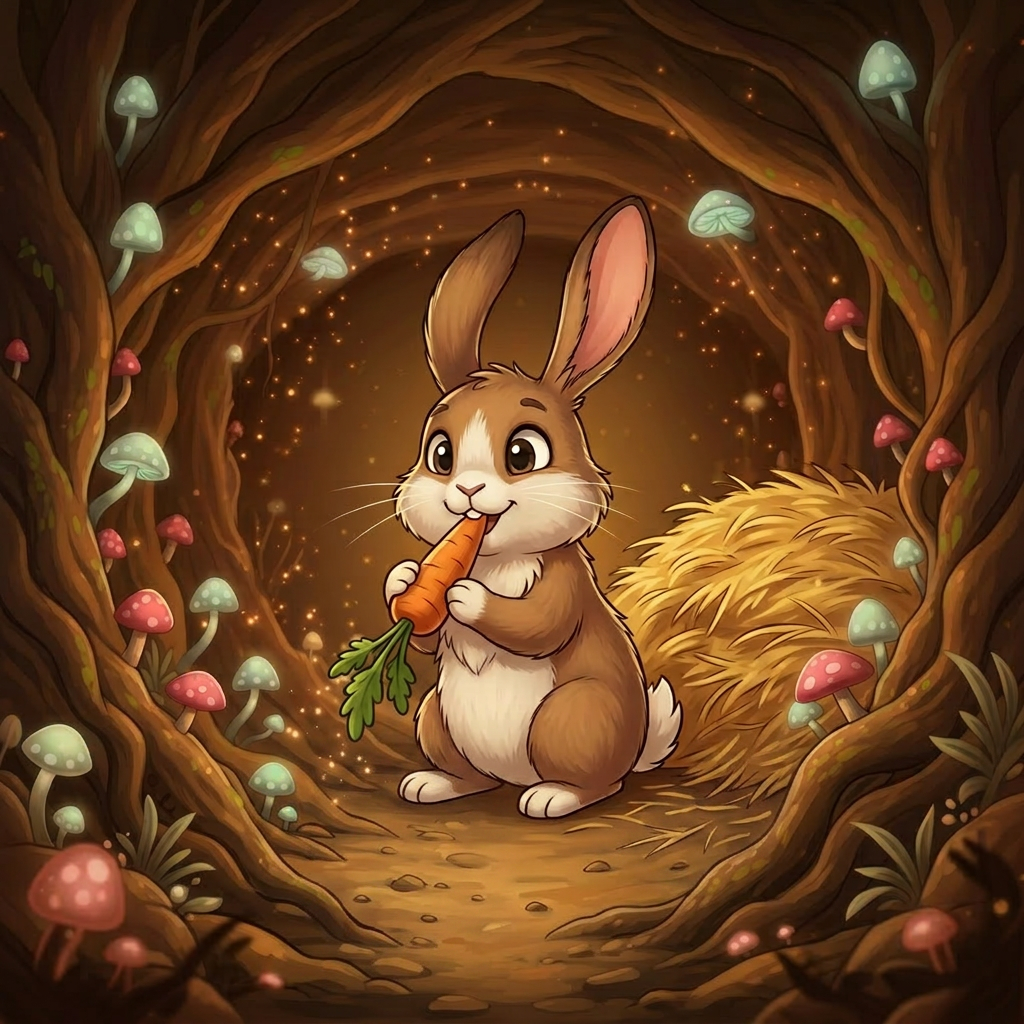
A real rabbit's staple isn't carrots at all, but hay and grass.
Constantly chewing on fiber-rich dried grass is essential for a rabbit's digestion and dental health.
So what about carrots?
Rabbits do like them, but as a root vegetable they're pretty high in sugar.
That's why a carrot is better as an occasional treat than a daily heap.
In other words, a carrot is less of a "main course" for a rabbit and more of a "dessert."
I used carrots anyway
Knowing all that, carrots went into the game regardless, because the image is already too strong to pass up.
A collectible has to read as "that's the thing you pick up" with no explanation at all.
Someone seeing the screen for the first time should be able to tell immediately.
A carrot does that job without a word.
With a rabbit as the protagonist, the carrot saves you a line of tutorial text.
I chose the thing that reads instantly over the thing that's biologically accurate.
In the game, a carrot is a path, not food
Once it was built, it turned out the carrot's real job wasn't being food.
It was showing the way.
Carrots aren't scattered individually; they're laid out in lines.
Those lines curve around the tunnel's circumference, or rise into the air and come back down.
A player chasing carrots ends up tracing that route without being told to.
So a line of carrots is really an arrow saying come this way.
This isn't something I invented — it's a technique collect-'em-up games have used forever.
Lay down things worth points and players follow the trail unprompted.
It means you never have to put "jump here" on the screen.
The airborne carrot rows above trampolines do exactly that.
The moment you see one, "I should bounce there" arrives on its own.
It's a way to teach jumping without explaining a button.
Generous hitboxes
Carrots have a fairly generous pickup radius.
Obstacles like rocks, by contrast, are given large ones.
That's deliberate.
With a collectible, "I thought I had that and missed" feels unfair; with an obstacle, "I don't think that touched me and I got hit" feels unfair.
So the radii differ: forgiving on what you collect, clearly readable on what hurts you.
Even with the same sphere check, one number completely changes the impression.
The golden carrot really is dessert
If ordinary carrots are signposts, golden carrots are the occasional reward.
Eat one and a magnet switches on briefly, pulling nearby carrots in on their own.
Just as a real carrot is a treat for a rabbit, only the special carrot gets special treatment in the game too.
So the carrots Mocha gathers down in her burrow are probably best thought of as an adventurer's sweet little fuel, rather than her everyday meals.
The scene Bugs Bunny was imitating
The film usually named as the source of the rabbit-and-carrot equation is 1934's It Happened One Night.
Its leading man leaning on a fence, chewing a carrot and talking fast, was widely quoted at the time, and around Bugs Bunny's first appearances the animators handed that attitude straight to a rabbit.
So Bugs chewing a carrot didn't come from observing that rabbits eat carrots — it was a parody of a human actor's gesture.
Decades of worldwide broadcast turned the parody into common knowledge.
The source of the image was a performance, not a field guide.
A rabbit's gut is built for grass
Why hay is non-negotiable becomes obvious from the anatomy.
Unlike a cow, a rabbit doesn't ferment fiber in the stomach — microbes break it down in the cecum, far down the tract.
Animals built this way are called hindgut fermenters.
The problem is that the cecum sits past most of the absorption.
So rabbits do something specific about it: they take the soft cecal pellets directly as they're produced and eat them again.
It usually happens in the early morning or at night, out of sight.
That second pass is how a rabbit actually gets its B vitamins and protein.
The whole arrangement assumes a constant intake of dry grass.
Too little fiber and gut motility slows, which throws off the microbial balance in the cecum.
Hay isn't a side dish for a rabbit; it's the condition under which the digestive system works at all.
Teeth follow the same logic.
A rabbit's teeth grow for life, and the sideways grinding of coarse hay is what keeps wearing them down.
On soft food alone the teeth overgrow, the bite misaligns, and eventually the animal can't eat.
So how much carrot?
None of this makes carrots bad.
It places them differently.
- Hay — the large majority of daily intake, available at all times.
- Leafy greens — about a handful a day, rotated across several kinds.
- Root vegetables like carrot — a treat. A slice or two a day depending on size.
One thing that surprises people: carrot tops beat the carrot. The greens carry far less sugar and much more fiber.
If you're in the habit of buying carrots and throwing away the leaves, you've been discarding the half a rabbit owner should keep.
The carrot's hitbox is 0.35m
The post above calls the collection hitbox "generous." Here are the actual numbers.
| Object | Collision radius |
|---|---|
| Mocha | 0.45m |
| Carrot | 0.35m |
| Rock | 0.7m |
| Magnet range | 3.5m |
Mocha plus carrot is 0.8m; Mocha plus rock is 1.15m.
In a tunnel with a 4m radius, that rock figure is substantially larger.
The gap in hitboxes is deliberately wider than the gap in apparent size.
Roots add the same idea from the other direction.
The collision thickness is 0.28m while the rendered thickness is 0.36m — about 29% fatter. The hitbox is thinner than what you see. That mismatch exists so you get "I thought that clipped me" rather than the reverse, which is the version that feels unfair.
And 3.5m of magnet range sits close to the tunnel's 4m radius.
With the magnet on, effectively the whole cross-section is in reach — which makes it less a tool that collects slightly more and more an item that changes the rules for eight seconds.
Next up: Rabbits in culture, and the origin of "rabbit hole" →