Why Do Rabbits Dig Burrows? — And How That Burrow Became a Game
Mocha endlessly digging her way down isn't pure fantasy.
There really are rabbits that dig into the ground and live inside it: the European rabbit, which also happens to be the ancestor of the pet rabbits we keep at home.
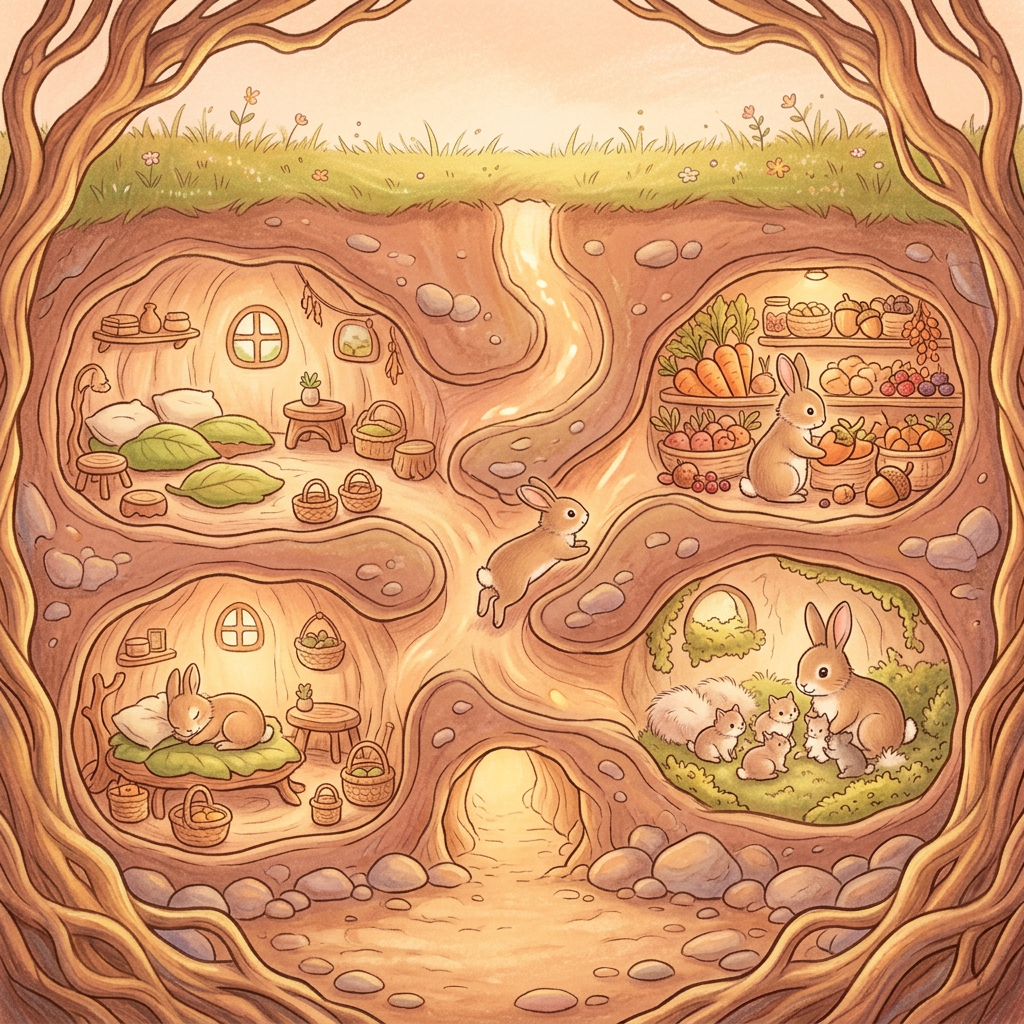
The burrows they dig aren't simple holes, but something closer to an underground city, with many entrances and tunnels woven together like a spiderweb.
In English, this whole network of burrows is called a "warren." Inside, there are separate chambers for sleeping and for raising young, and it's all designed so that when danger strikes, the rabbits can scatter and flee through multiple exits.
The burrow is both home and shelter for a rabbit.
Up on the surface there are plenty of predators hunting them, but it's hard for those predators to chase a rabbit deep into a narrow tunnel.
Underground is also far more stable for escaping the heat of midsummer and the cold of midwinter.
What's interesting is that not all rabbits dig burrows.
Species like North America's cottontail tend to hide in thickets or borrow holes others have already dug, rather than digging their own.
Diligently turning over the earth is really the burrowing rabbit's specialty.
Why the branching paths had to go
From here on, these are the choices I made turning that burrow into a game.
The first thing I gave up was the branching that defines a warren.
Real burrows split and lead into chambers, and building that faithfully produces a maze game rather than a runner.
Every fork makes the player stop to ask which way is right, and the sense of speed dies in that pause.
What this game sells is the fun of reacting quickly, so the path stays single and fixed.
Instead I made the burrow bend continuously left and right.
Even without forks, anything that isn't straight reads as dug by hand.
The difference between a pipe bored along a ruler and a tunnel clawed downward is really that irregularity.
The curve isn't drawn in advance either — it's a few sine waves layered together, so no matter how deep you go the same shape never repeats.
What being round gave me
The fact that a burrow is round I leaned into rather than worked around.
A typical runner has you on a floor moving between three lanes; here Mocha can run anywhere around the tunnel's circumference, including upside down along what would be the ceiling.
That's not decoration, it followed naturally from the setting.
And once the space you can move through is a circle rather than a line, the ways an obstacle can be placed get far more varied.
The things in the soil
Real burrows go through soil, which means running into tree roots.
So roots became the signature obstacle.
A root is an arc across the tunnel's circumference, so you can't slip around it sideways — you have to jump.
That "no sideways escape" property creates a different kind of decision than a rock does.
The scatter on the walls came from the same thinking.
Pebbles, dark patches of soil, mushrooms, and drifting fireflies are laid out differently in every section.
Without them the tunnel reads as a smooth cylinder, which feels extruded rather than excavated.
They have no effect on play at all, but they're what says you are inside earth.
Mocha, it seems, inherited that hard-working bloodline.
Her burrow is just far simpler than a real warren, and far deeper.
The holes in a warren have names
Not every opening in a warren is the same kind of opening.
They divide into two.
The large entrances slope down and are where the rabbit pushed excavated soil out, so there's a mound in front.
The other kind is dug upward from inside — no mound, just a hole in the ground.
Those are closer to fire exits.
If a predator is watching the main entrance, there's still a way out.
Nursery chambers are often dug as a separate short burrow away from the main system, and the mother may plug the entrance with soil after each visit.
It separates the kits even from the other rabbits in the warren.
Digging and group living are two sides of one thing.
A large warren isn't one animal's work but generations of it, and a hierarchy forms inside.
The best spots — deep, protected inner chambers — go to higher-ranking individuals.
The solitary cottontail not digging and the European rabbit living in groups are the same fact told from either end.
The curve is made of six pieces
The burrow appears to bend forever, but only six wall segments exist at any moment.
Each is 30m, so what's in front of you is always 180m of tunnel.
Once Mocha descends one segment's length, the rearmost piece jumps to the front and is regenerated as new terrain.
You're running on a conveyor belt.
Which means nothing accumulates as the burrow deepens.
At 1,000m or at 10,000m, there are six wall segments.
The curve itself isn't a pre-drawn path but several sine waves summed together.
Adding waves with different periods pushes the combined repeat far enough out that no human session sees the same shape twice — which is how "a different burrow every time" happens without storing any terrain.
There's a ceiling on curvature, though.
Bend too hard and the exit 180m ahead slides off-screen, leaving nothing but wall.
It has to bend to read as a burrow and can't bend so much that you can't see.
The current amplitude and wavelength are the value found between those.
Two seconds for a full lap
Choosing a round tunnel brought one number with it: Mocha's maximum angular speed around the wall is 3.2 radians per second.
A full circle is 6.28, so at full speed a lap takes about two seconds.
That value sets a surprising amount of the game's character, because it means crossing to the opposite side takes roughly one second.
Set that against the 2-second combo window and reaching for a carrot across the tunnel becomes arithmetically marginal.
It's a judgment call that a three-lane runner would never produce.
Acceleration and damping sit on top.
Holding a key doesn't snap you to top speed — you gain 14 radians per second squared, and releasing coasts to a stop.
That's why reversing twice is too slow: turning the other way means killing the current rotation first.
Everything stuck to the walls is decoration
The pebbles, soil patches, mushrooms, and fireflies have no collision.
Pass through them and nothing happens.
They exist purely to say "this is underground."
Take them away, though, and something breaks: a smooth cylinder has no sense of speed.
With no markings on the wall there's no way to see how fast you're descending.
Something has to pass by for motion to register.
So they're decoration and speedometer at once.
How finely the wall is subdivided is tangled up in this too.
The circumference is drawn in 48 pieces and the length in 24 — originally 24 and 12.
With fewer pieces the shading boundaries broke into visible wedges, and the tunnel read as an angular pipe rather than something dug by hand.
Since only six segments are ever live, tripling the vertex count left plenty of headroom, so it got raised.
As much as the branching paths that were cut, a value like this decides whether it looks like a burrow.